
Clear Answers When Your Pet Can’t Tell You What Hurts
A limp, a cough, or a swallowed sock can leave you worried and waiting. At LBC Vets in Long Beach, CA , digital radiology lets our veterinarians see inside your dog or cat within minutes. We find the cause faster and start treatment sooner, with less radiation and less stress for your pet. Because we’re open 24 hours a day, 7 days a week, imaging is available when your pet needs it, day or night.
request an appointmentHow Digital Radiology Supports Your Pet’s Care
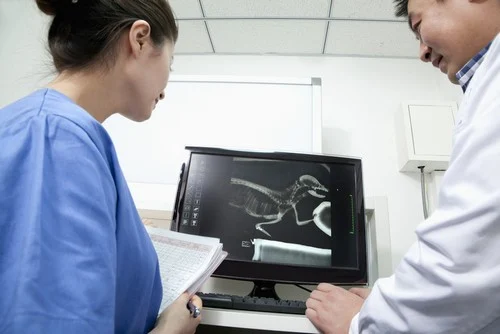
Digital radiology has changed how veterinarians diagnose dogs and cats. Our system uses digital sensors instead of traditional film. Images appear on a computer screen within moments, and your veterinarian can enlarge them, adjust them, and review them with you right away. This fast, non-invasive tool gives our team the detail needed to make confident decisions about your pet’s health. It is a key part of our advanced digital X-ray services.
What Is Digital Radiology?
Digital radiology, also called digital X-ray, is a modern imaging method. It captures images electronically rather than on film. There is no darkroom and no chemical processing, so results are ready almost immediately. The images are also easy to store in your pet’s medical record and to share with specialists when a second opinion would help.
Benefits of Digital X-Rays for Dogs and Cats
- Sharper, more detailed images: Digital X-rays show finer detail than film. Our veterinarians can adjust brightness, contrast, and zoom to examine small structures closely.
- Results in minutes: Images are ready right away, so diagnosis and treatment can begin during the same visit. Shorter waits also mean less stress for your pet.
- Lower radiation exposure: Digital radiology needs less radiation than traditional X-rays, which makes it a safer choice for your pet and our team.
- Better for the environment: No film or processing chemicals are needed, which reduces waste.
- Easy sharing: Images can be sent to specialists in moments, which helps with complex cases and keeps your pet’s records complete.
When Your Veterinarian May Recommend Radiology
Digital radiology helps with many conditions in dogs and cats, including:
- Bone and joint problems: fractures, arthritis, and developmental conditions such as hip dysplasia.
- Dental health: checking teeth, roots, and jawbones for disease hidden below the gumline, often as part of pet dental care.
- Abdominal concerns: swallowed objects, bladder stones, masses, and changes in the liver, kidneys, or intestines.
- Chest imaging: evaluating the heart and lungs for pneumonia, heart disease, fluid, or tumors.
- Surgical planning: detailed images before surgery to guide the procedure and support the best outcome.
- Urgent and emergency situations: trauma, sudden lameness, trouble breathing, or suspected blockages that need answers quickly.
What to Expect During Your Pet’s X-Rays
- Preparation: Depending on the area being imaged, your pet may need to fast beforehand or receive mild sedation to stay calm and still.
- Positioning: Our team gently positions your pet on the table, taking care to keep them comfortable throughout.
- Imaging: Taking the images is quick and painless and usually lasts only a few minutes.
- Results: Your veterinarian reviews the images on screen and walks you through the findings and next steps.
Why Choose a Long Beach Veterinary Hospital with Digital Radiology?
Choosing a hospital with digital radiology means your dog or cat gets accurate, fast, and safe imaging without being sent elsewhere. At LBC Vets, radiology works alongside our in-house lab and other diagnostic tools. This lets our veterinarians build a complete picture of your pet’s health and act quickly. For more details on the technology, visit Antech Sound’s digital X-ray page.
Digital Radiology Questions from Pet Owners
Are digital X-rays safe for my dog or cat?
Yes. Digital radiology uses less radiation than traditional film X-rays, and each image takes only a moment. Our team uses protective equipment and takes only the images needed to answer your veterinarian’s questions.
Will my pet need to be sedated for X-rays?
Not always. Many calm pets can be imaged while awake. Pets who are anxious or in pain, or who need precise positioning (such as for hip or dental images), may receive mild sedation to keep them comfortable and still.
How long does a digital X-ray appointment take?
Taking the images usually lasts only a few minutes. Your total visit may be longer if your pet needs an exam, sedation, or recovery time, but results appear almost immediately so you won’t wait days for answers.
Does my pet need to fast before X-rays?
It depends on what is being imaged and whether sedation is planned. Abdominal images and sedated studies often call for fasting. Our team will tell you exactly how to prepare when you schedule.
Can digital X-rays find something my pet swallowed?
Often, yes. Radiographs show many foreign objects, such as bones, rocks, and metal, and can reveal signs of a blockage. Some items, like fabric or plastic, may need more images or other diagnostics to confirm.
Can I see my pet’s X-rays?
Absolutely. Because the images are digital, your veterinarian can show them to you on screen, point out any findings, and explain the treatment options in plain language.
Can I bring my pet in for X-rays after hours?
Yes. LBC Vets is open 24 hours a day, 7 days a week, so digital radiology is available whenever your pet has an urgent problem. Call (562) 579-4485 and let us know you’re on the way.
Get Fast, Accurate Answers for Your Pet
If your dog or cat is limping, coughing, vomiting, or just not acting like themselves, our team can help you find out why. Book a visit with LBC Vets in Long Beach, CA , or call (562) 579-4485. We’re here 24/7.